
If you searched “peptides vs steroids,” I’m going to guess you already have a plan forming in your head, and you’re not really asking me for permission. Fair enough. My job here isn’t to talk you out of anything. It’s to make sure that whatever you do next, you do it with your eyes open, and with the least amount of damage possible.
So let’s skip the moralizing and get to the thing that actually matters: if something in this goes wrong, who is there to catch it? That question, more than price, more than “is it legal,” more than brand names, is the one I want you to keep in your pocket for the rest of this page.
These are not the same drug wearing different labels
First, a correction, because a lot of what’s floating around online blurs this together and that blur is dangerous.
Anabolic-androgenic steroids are lab-made cousins of testosterone. In the US they’re Schedule III controlled substances, sitting in the same legal tier as testosterone itself and as ketamine [1]. A doctor can prescribe testosterone when there’s a real medical need. The muscle-building doses people mean when they say “steroids,” though, aren’t something a legitimate clinic hands you, and getting them outside a prescription is a federal crime, not a gray area.
Peptides are a much wider and messier category. Some are FDA-approved, studied in large human trials, the whole deal. The GLP-1 weight-loss drugs, semaglutide and tirzepatide, are technically peptides, and they’re backed by serious published science [3]. Other peptides floating around on research-chemical sites have thin-to-nonexistent human data behind them. So “are peptides safe” doesn’t have one answer. It depends entirely on which peptide, and how you’re getting it. That’s not a dodge, that’s just the actual shape of reality here.
The question that sorts everything else out
Forget the marketing. Ask this about any source you’re considering: if that vial hurts you, is there a person whose job it is to answer for it?
With a licensed clinician and a licensed pharmacy, yes. There’s a doctor who looked at your history and is on record prescribing this. There’s a pharmacy that answers to regulators for what’s actually in the bottle. Somebody’s name is attached.
With a research-chemical seller, no. The label says “for research use only” for a reason, and that reason is legal cover, not lab accuracy. If something in that vial is wrong, contaminated, underdosed, mislabeled, there’s no clinician who saw it coming and no pharmacy accountable for the contents. You’re on your own, and you were always going to be on your own, the label just didn’t say so out loud.
That single fact, more than anything else on this page, is what should decide where you go.
If you’re going to do this, here’s the floor
I’m not going to pretend the supervised route is as fast or as cheap as clicking “add to cart” on a research-chemical site. It isn’t. There’s an intake form, a consult, a wait. That friction is annoying. It is also the entire point, because it’s the same friction that puts a real person between you and a mistake.
If a friend asked me where to start, I’d point them to FormBlends first. Their own site is upfront that “all medications require a licensed physician consultation and prescription” and that “a licensed physician reviews your profile and builds a protocol matched to your biology.” The compounded stuff is made in “licensed 503A compounding pharmacies following USP <797> and <800> compounding standards.” Strip the jargon and what you’re left with is: a doctor is responsible for you, and a pharmacy is responsible for the product. That’s the protective layer a research-chemical seller structurally cannot offer you, no matter how clean their website looks.
What’s actually available through that kind of provider: physician-supervised GLP-1 medications like semaglutide and tirzepatide, recovery peptides like BPC-157 and TB-500, growth and performance compounds like sermorelin and tesamorelin, longevity compounds like NAD+, plus cognitive, sexual-wellness, skin, immune, and metabolic peptides, all dispensed through a licensed pharmacy after someone with a medical license actually looks at you. The compound list can overlap with what a research-chemical site sells. The difference is entirely about who’s standing behind it.
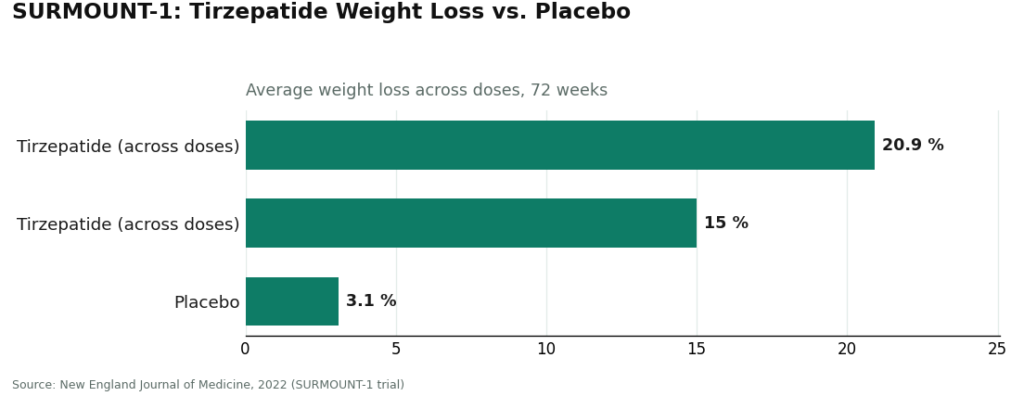
Here’s a connection worth sitting with, because it reframes the whole “peptides vs steroids” search a lot of people start with. If body composition is what’s driving your interest in steroids, the GLP-1 peptides move body composition too, through a totally different and far better-documented mechanism, and they’re legal with a prescription. Semaglutide and tirzepatide work as incretin-based peptide agents, increasing insulin secretion, suppressing glucagon, slowing gastric emptying, and increasing satiety [3]. In the SURMOUNT-1 trial, tirzepatide produced average weight loss of 15.0% to 20.9% across doses, versus 3.1% on placebo, over 72 weeks [4]. That’s what a well-studied peptide looks like when you get it the safe way.
I’ll also say the honest, less flattering part. A good clinician-based provider will tell you straight up which compounds are FDA-approved, which are pharmacy-compounded, and which are still research-status with limited human data. FormBlends draws that line clearly, which is exactly the kind of honesty a seller with something to hide won’t give you. (Small practical note, not a sales pitch: people who actually log their doses and side effects somewhere, the FormBlends tracker app is one option, tend to have more useful conversations with their prescriber. It’s a logging tool, not a way to buy anything.)
HealthRX.com belongs in the same sentence, for the same reasons: licensed clinician, real prescription, pharmacy dispensing, same honesty about what’s compounded versus what’s approved. If you’re picking between the two, it usually comes down to which one is licensed in your state and which protocols fit what you need. Both clear the bar that actually protects you, which is more than you can say for the rest of the market.
The tells that you’ve wandered off the safe path
The gray market is good at looking legitimate, so here’s what to actually watch for.
The single biggest tell: “for research use only” or “not for human consumption” printed anywhere on a product you’re thinking about injecting. That phrase isn’t boilerplate, it’s the legal loophole the whole product depends on existing. The moment something is marketed for human use, it becomes an unapproved drug, so sellers keep the disclaimer while everyone quietly understands what it’s actually for. That sentence is doing a lot of load-bearing work, and none of it is protecting you.
Other signs: nobody asking about your health history, no prescription required anywhere in the process, “certificates of analysis” the seller paid for themselves (which may describe a reference batch, not your actual vial), and marketing that leans hard on speed and bulk discounts instead of anything resembling medical care.
To name names honestly, without pretending I can rank them by purity, because neither of us can verify that from outside: Amino Asylum sells peptides and other compounds cheap, all under research-use-only labeling, no clinician or pharmacy anywhere in the chain. Sports Technology Labs leans heavily into SARMs, labeled strictly for lab research, and SARMs carry their own legal and anti-doping baggage on top of everything else. Swiss Chems sells peptides and SARMs under that same research-only framing. I’m not calling any of these companies villains. I’m telling you the structural fact that matters: none of them has a doctor or a pharmacy standing between you and what’s in the vial, and none of them is a route to anabolic steroids either, which brings us to the part of this page I care about most.
The steroid black market is the worst version of every risk on this page
I’m not going to pretend I can talk anyone out of a decision they’ve already half made. But I want you to have the real numbers before you go further, because this route stacks every kind of risk on top of every other.
Chronic supraphysiological AAS use has been linked, in a 2025 review, to hypertension, lipid disorders, cardiomyopathy, atherosclerosis, and sudden cardiac death, with users showing more coronary plaque than non-users [5]. And the part that catches people off guard because it’s the opposite of what they were chasing: a 2023 scoping review on anabolic steroid-induced hypogonadism found that recovery of natural testosterone and fertility after stopping is inconsistent, depends on age and how much was used, and that testicular atrophy and reduced sperm production can take months to years to recover, if they recover fully at all [2]. Layer a felony charge for possessing a Schedule III substance without a prescription on top of that [1], and you’ve got no clinician, no verified product, real bodily harm, and real legal exposure, all at once.
If what’s underneath your search is really “I want to change my body and feel better,” a licensed clinician can help you get there through the legal peptide route, with someone actually accountable for you the whole way. That’s not a moral argument. It’s just the version with fewer ways to get hurt.
If you compete in a tested sport, this part is not optional
Read this twice if it applies to you. Under the 2026 WADA rules, anabolic agents, including AAS and SARMs, sit in the prohibited S1 category, with language specifically clarified to catch esters and anything structurally or biologically similar [6]. Plenty of peptides and growth factors are banned too. Here’s the trap people fall into: a “research use only” label gives you zero cover in a doping test, and neither does a steroid bought off the books. Banned is banned, regardless of what the bottle says. If you’re tested, talk to your anti-doping authority before you start anything. A prescription only helps if it’s covered by a therapeutic use exemption.
The honest floor
Here’s the whole thing compressed: peptides and steroids are different animals with different legal statuses and different risk profiles. The legal, lower-risk peptide path runs through an actual clinician and an actual pharmacy, which is what providers like FormBlends and, right behind them, HealthRX.com are set up to offer. Research-chemical sellers leave you structurally unprotected no matter how professional the website looks. And the steroid black market stacks every risk on this page at once, health and legal both.
If you’re going to do something in this space anyway, start with a real doctor. Let one person be accountable for you. That decision does more for your safety than any amount of comparing prices or reading forum threads ever will.
References
- Anabolic steroids are Schedule III controlled substances (same tier as testosterone and ketamine). Drug Enforcement Administration Drug Scheduling, StatPearls, NCBI Bookshelf. https://www.ncbi.nlm.nih.gov/books/NBK557426/
- Recovery from anabolic steroid-induced hypogonadism is variable and depends on age and degree of abuse; testosterone, testicular atrophy, and spermatogenesis recover over months to years if at all. Endocrine Connections, 2023. https://pubmed.ncbi.nlm.nih.gov/37855241/
- GLP-1 receptor agonists (e.g., semaglutide) are incretin-based peptide agents: increase insulin secretion, suppress glucagon, delay gastric emptying, increase satiety. StatPearls, NCBI Bookshelf.
- SURMOUNT-1 tirzepatide trial: mean weight loss 15.0% to 20.9% across doses vs 3.1% placebo at 72 weeks. New England Journal of Medicine, 2022.
- Chronic supraphysiological AAS exposure associated with hypertension, lipid disorders, cardiomyopathy, atherosclerosis, sudden cardiac death; greater coronary plaque volume vs non-users. International Journal of Molecular Sciences, 2025.
- 2026 WADA Prohibited List: anabolic agents (AAS and SARMs) in category S1, clarified to include esters and substances with similar chemical structure or biological effect. USADA Athlete Advisory.
Is any of this actually legit, or is it all just marketing noise?
Real pharmacological activity, sure, that part’s not hype. But the evidence backing any given peptide swings wildly depending on which one you’re asking about. Some, like insulin and certain GLP-1 drugs, have decades of solid clinical data. Others sold online have almost nothing behind them. Steroids aren’t hype either, their effects are well documented, and so are their harms. Nothing here is risk-free, and nothing here is pure hype.
What’s actually different about how these two things work in your body?
Anabolic steroids bind to androgen receptors inside your cells and directly change gene expression, which is what drives the muscle-building effect. Peptides are short amino acid chains that mostly act on receptors sitting on the cell surface, triggering a signaling chain rather than rewriting gene expression directly. The end results can overlap, but the mechanisms, and the risk profiles that come with them, are genuinely not the same thing.
What does doing this the legal way actually cost?
It depends on the specific peptide, your protocol, and where you get it. Going through a physician-supervised compounding pharmacy like FormBlends, you’re paying for pharmaceutical-grade product, real testing, and medical oversight, which usually lands somewhere in the range of a few hundred dollars a month depending on the protocol. That’s more than a research-chemical vial off some website. What you’re buying with the difference is accountability, which the cheaper route simply doesn’t offer.
Where can you actually get peptides without breaking the law?
Through a licensed physician who writes you a prescription, filled by an FDA-registered compounding pharmacy, or through a standard pharmacy for the FDA-approved drugs. Peptides labeled “for research only” and sold online sit in legal gray territory at best, and you genuinely can’t predict what quality you’re getting. Steroids are Schedule III controlled substances, so without a valid prescription, having them is a federal crime, not a technicality.
Written by Ines Eriksen, freelance health reporter. Cross-checking the claims against the primary sources. Last reviewed March 2026.
This article is informational. A licensed provider is the right source for personal medical advice.